Baby Carrots Did Baby Carrots Happen in Nature
NEWYous tin now heed to Fox News manufactures!
Babe carrots have long been a favorite lunch box staple. Parents love them because they're conveniently sized and they're seen equally a healthy food choice. Kids love them considering they're sweet and pretty fun to eat...every bit far as veggies go.
Merely what's the existent deal behind baby carrots?
Later on all, they don't really look like regular carrots. They're perfectly shaped with rounded edges; they don't have the same thick core; and, even peeled, they're bright orange. Just they are a vegetable, right? A quick Google search for baby carrots turns up some frightening "information" on how they're made and whether they're actually "soaked in chlorine" to preserve that signature colour and crisis.
What'southward upward with that?
We decided to dig upwardly the truth on babe carrots, and hither'due south what we found.
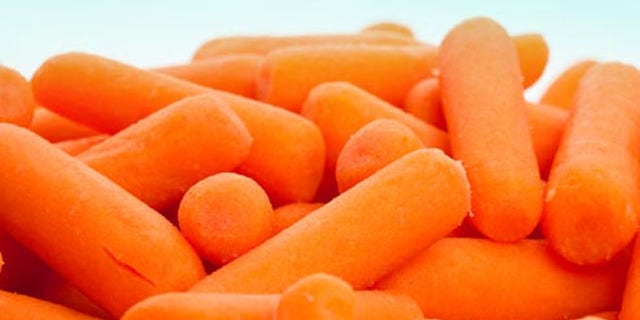
Most baby carrots sold in U.S. supermarkets are really what the industry calls "baby cuts." These babies are made from longer carrots that have been peeled and cut into a smaller size. These carrots take as well been bred to be smaller in diameter, coreless and sweeter than regular carrots.
Bob Borda, a spokesman for Grimmway Farms, the globe's largest carrot grower (they handle 10 million pounds every day), says that over the years the company has developed a hybrid that combines the best qualities from over 250 known commercial varieties.
"Naturally, you brood carrots to get the sweetest flavour and crunch," he told FoxNews.com.
But infant carrots didn't offset out that way. Prior to the mid-1980s, broken and misshaped carrots were discarded, leaving some farmers with as piddling as 30 percent of their crop to take to stores. Tired of throwing away perfectly adept nutrient, California carrot farmer Mike Yurosek took those carrots and used a potato peeler to reshape them into small pieces more suitable for quick munching. When his mini carrots proved popular among locals, Yurosek purchased an industrial green bean cutter to quickly whittle the carrots into the familiar 2-inch portions we even so run across today — and from at that place, baby carrots actually took.
Baby carrot products have been the fastest growing segment of the carrot industry since the early 1990s and are among the nigh popular produce items in the supermarket aisle – more than potatoes and celery, co-ordinate to a 2007 USDA study.
While Yurosek's baby cut carrots have evolved, there is however a persistent concern from some consumers over how they're grown and processed.
In guild to create thinner vegetables, baby carrots are planted closer together than traditional carrots. In equally petty as 120 days from planting, the carrots are dug up and trucked to the processing business firm to exist cutting and peeled. Merely before packaging, all carrots receive a brisk scrub accompanied by a chlorine bathroom.
Wait, what? Chlorine, you say, as in the same chemical you discover in the community pool?
Borda says Grimmway Farms, whose labels include Cal-Organic, uses a chlorine solution on all its carrots – organic and non-organic -- to prevent food poisoning, before a final wash in water. Grimmway says the chlorine rinse is well inside limits set by the EPA and is comparable to levels found in tap h2o.
Ashley Bade, a nutritionist and founder of Honest Mom Diet, says the chlorine bath is a standard practice in many pre-cut nutrient items. "The chlorine-water solution is a needed step in the process to limit the gamble of nutrient-borne illnesses such as Due east.coli," she says.
Yet the controversy over chemical rinsing has caused a minor uproar among organic communities and concerned parents wanting to rid their children'due south lunchboxes of potentially dangerous chemicals.
When FoxNews.com contacted Bolthouse Farms, the nation's second largest carrot producer, spokeswoman Kathleen Corless said the visitor didn't want to exist interviewed. "Nosotros don't desire to keep perpetuating the myth that babe carrots are dyed or bleached," she said.
"I have had clients bring up concerns regarding baby carrots after some rumors about the processing of infant carrots involving 'soaking them in chlorine or bleach,'" Bade said, adding that the carrots are prophylactic to swallow.
The truth is that baby carrots are no dissimilar from packaged lettuce or any other prepared produce -- like bagged lettuce -- that you lot'll find in the grocery store.
Nutritionists say consumers concerned almost chlorine rinses can just buy whole, unprocessed carrots and wash, peel and cutting them up at dwelling-- how old fashioned.
Dr. Aruna Weerasooriya, researcher and professor of agricultural sciences at Prairie View A&G University, says a perhaps larger, less known wellness concern is how the manipulation of certain vegetables degrades their nutritional value.
"When you look at wild carrots, they have high levels of Thymol, a phyto-chemical that is essential for the body to control leaner and ward off viral infections," he said. "Now, when you look at some of these new carrot breeds, this blazon of phytochemical just isn't at that place."
Weerasooriya believes that carrot companies are trading in nutritional value for increased convenience to the customer – and profit for themselves. "Research should focus on how to retain some of these nutrients, only instead companies are probably more concerned most a longer shelf life."
Source: https://www.foxnews.com/food-drink/the-truth-behind-baby-carrots

Postar um comentário for "Baby Carrots Did Baby Carrots Happen in Nature"